
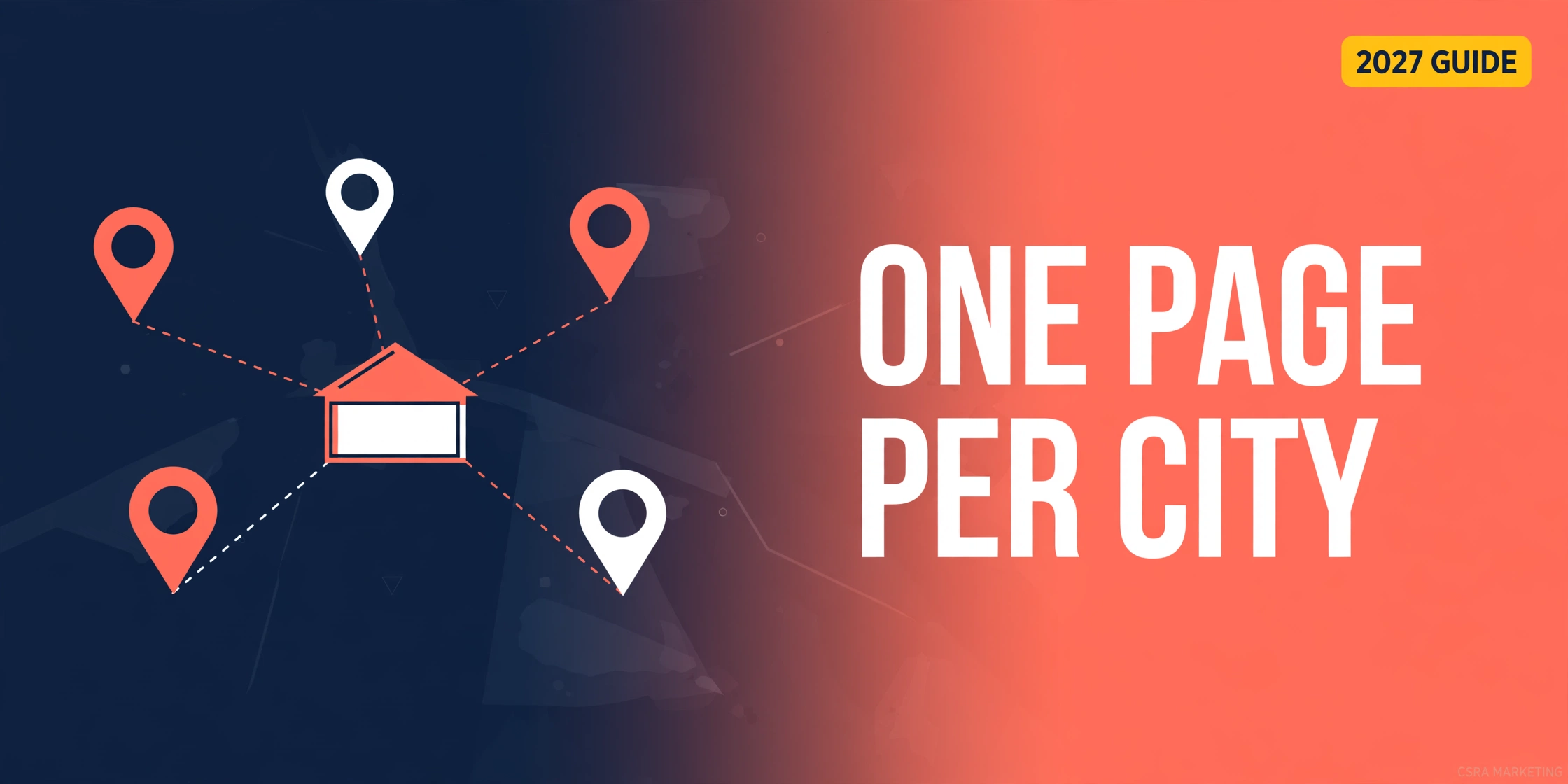
You replace roofs in five towns but only show up on Google in one of them. That is not a Google problem. That is a you problem.
A service area page tells Google you serve each town by name. Without one, you are invisible everywhere except your home base. And every invisible town is a month of jobs going to the roofer who bothered to make the page.
This guide covers what service area pages are, why Google rewards them, and how to know whether yours will rank or get ignored. Run your numbers through the lead cost comparison tool first if you want to see what a second or third ranking town is actually worth to you.
Chapter 01
Your Hometown Rankings Do Not Follow You Down the Highway
Google ranks you for where you are, not where you drive to. That is the whole problem in one sentence.
Your office sits in one town. Your crew works in six. Google knows about the first one. The other five get your competitors. That is the price of having no location presence on your site.
Here is the deal: proximity is one of the three local ranking factors Google weighs. I covered all three in my breakdown of how Google ranks roofers in the map pack. When a homeowner in the next town searches "roofer near me," Google prefers the roofer whose site says that town by name over the roofer whose site never mentions it.
You cannot move your office to every town. But you can build a presence on your website for each one. That presence is a service area page.
Chapter 02
A Service Area Page Is a Page That Says "We Roof Here"
Strip away the jargon and it is simple. A service area page is a dedicated page on your site for one specific town or city you serve.
It says three things. Picture it as your page speaking directly to that town's homeowners: "We roof here. Here is what we do in your town. Here is how to reach us." That is it. It is a landing page with a zip code.
It is not your homepage with a town name swapped in. It is not a blog post. It is a permanent page that lives in your site's navigation, tells Google this town matters to your business, and gives homeowners in that town a reason to call you instead of whoever is ranking there now.
If you are new to how local search works for roofers, my explainer on what local SEO is for roofing companies sets the foundation. This post is the next step: the actual pages that make the strategy work.
Chapter 03
Why Google Rewards Pages That Name Towns
Google's job is to show the searcher the most relevant answer. Relevance is one of the three local ranking factors, and it is the one you control most.
A page that talks specifically about roofing in one town is more relevant to a search for "roof repair in [that town]" than a homepage that talks about your whole metro area. Google is matching specificity with specificity. That is the entire SEO logic behind service area pages.
Why?
Because Google's own documentation on how it ranks local results lists relevance as a core factor, right alongside distance and prominence. A dedicated page for a town is the clearest relevance signal you can send for searches tied to that town.
This is also why a single "Service Areas" page listing twenty towns in bullet points does almost nothing. One page cannot be the most relevant result for twenty different towns at once. Each town needs its own page, or none of them win.
Chapter 04
The 5 Signs Your Site Needs Service Area Pages Right Now
You might already know the answer. But here is the checklist I run through with roofers, because guessing wrong costs you months.
One, you only rank in your home town. Search your main keyword from a phone in the next town over. If you are nowhere, that town needs a page. This is the most common symptom and the easiest to confirm.
Two, your competitors outrank you in towns you both serve. If another roofer shows up in a town you work in every week, they probably have a page for it. They planted the flag. You did not.
Three, you have one "Service Areas" page. A bullet list of towns on a single page tells Google about as much as a billboard tells drivers. It names towns. It does not prove relevance to any of them.
Four, your Google Business Profile lists a service area but your site does not. Your profile says you serve six towns. Your website mentions one. Google notices the mismatch. Consistency between your profile and your site strengthens both.
Five, you are turning down or losing jobs in specific towns. If your close rate is fine at home but weak two towns over, it is often a visibility problem, not a sales problem. Homeowners cannot call a roofer they never find.
Here is the deal: if two or more of these are true, service area pages are not optional for you. They are the highest-leverage SEO move you can make this quarter. The lead cost comparison tool will show you what each new ranking town is worth in real dollars, so you can prioritize which towns get pages first.
Want to know what a second ranking town is worth to you?
Run the numbers in the free lead cost comparison tool and see the dollar value before you pick which town to build for first.
Compare my lead costsChapter 05
What Makes a Service Area Page Rank vs. Get Ignored
This is where most roofers get it wrong. They hear "make a page for each town" and they make twenty thin pages with the town name swapped. Google ignores all of them. Sometimes it penalizes the site.
A page that ranks has three qualities. A page that gets ignored is missing at least one of them.
First, it is genuinely useful to a homeowner in that town. It answers the questions someone there would actually ask. Storm patterns differ by town. Permit rules differ by town. A page that could have been written for any town reads like it was written for no town, and Google treats it that way.
Second, it is unique. Not templated. Not the same three paragraphs with a find-and-replace on the town name. Google has seen that trick millions of times. Unique content is what separates a page that ranks from a page that gets filtered out as duplicate.
Third, it connects to the rest of your site. It links to your main service pages. Your service pages link back to it. It sits in a logical place in your navigation, not buried five clicks deep. Google follows these connections to understand that the town is a real part of your business, not an afterthought.
Bottom line? One strong page beats ten thin ones. If you can only do three towns well, do three. Do them right. Expand later.
Chapter 06
The Revenue Math on Ranking in One More Town
Let me show you what a single additional ranking town is worth, because this is where owners stop thinking of SEO as an expense and start thinking of it as inventory.
Take a typical mid-size market. For this example, say the new page pulls 40 extra visitors a month once it ranks. That is an illustrative number to show the shape of the math, not a promise of traffic.
At an illustrative conversion rate of 2 to 5 percent, those 40 visitors turn into 1 or 2 leads a month. This is an illustrative worked example, not a promise, but the shape of it holds: a little visibility in a new town is a little pipeline.
The math on one more ranking town
One extra lead a month, a 25 to 35% close rate (my professional read of a healthy roofing close rate), one job every 3 to 4 months at $4,800 in gross profit per job ($12,000 roof at 40% margin).
One page. Built once. Working while you sleep. Now multiply that by the five towns you actually serve.
Five towns at the same math is $70,000 to $95,000 a year in gross profit sitting on the table. From pages built once. (Still the same illustrative example, extended.)
Chapter 07
The One Mistake That Can Backfire
There is a wrong way to do this, and I would rather you hear it from me than learn it from a ranking drop.
Google calls mass-produced, near-duplicate location pages "doorway pages." The idea is pages built for search engines, not people.
Twenty town pages with identical content and a swapped name are exactly what Google is looking for when it hands out penalties. A doorway page penalty can pull those pages out of search results entirely, and sometimes it drags the rest of your site down with them. That is the risk of the shortcut.
The rule is simple. If a human reading two of your town pages would feel like they already read the other one, you have a problem. Each page needs to stand on its own as genuinely different and genuinely useful.
This is also why I do not recommend letting anyone build you fifty location pages in a week. Speed is the tell. A page that ranks took real thought about that town. A page that was generated in bulk did not, and Google can tell the difference.
If you want an honest read on whether your current site has this problem, or an opportunity you are sitting on, run the website audit. I will tell you exactly which towns you are invisible in and what it would take to fix it. Or book a call with me and I will map it out with you.
Frequently asked questions
How many service area pages should a roofing company have?
Will service area pages help me rank in the map pack?
Can I just copy my homepage and change the town name?
How long does it take for a service area page to rank?
Do service area pages work if I work from home and have no office?
Should I make pages for towns I might expand into later?
What is the difference between a service area page and a location page?
Does Roofing SEO Actually Work? What Roofers Should Expect in 2027
What roofing SEO can and cannot do, and what to expect before you spend money on it.
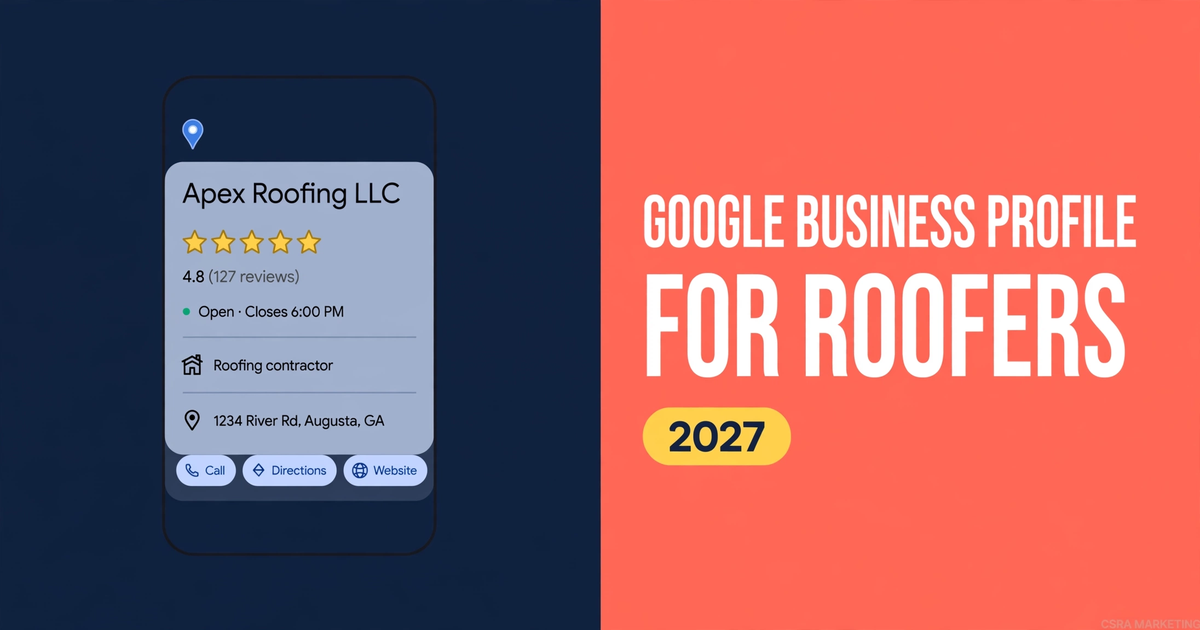
How to Set Up and Optimize Your Google Business Profile as a Roofer
How to set up and optimize your Google Business Profile, and what each field does for a local roofer.
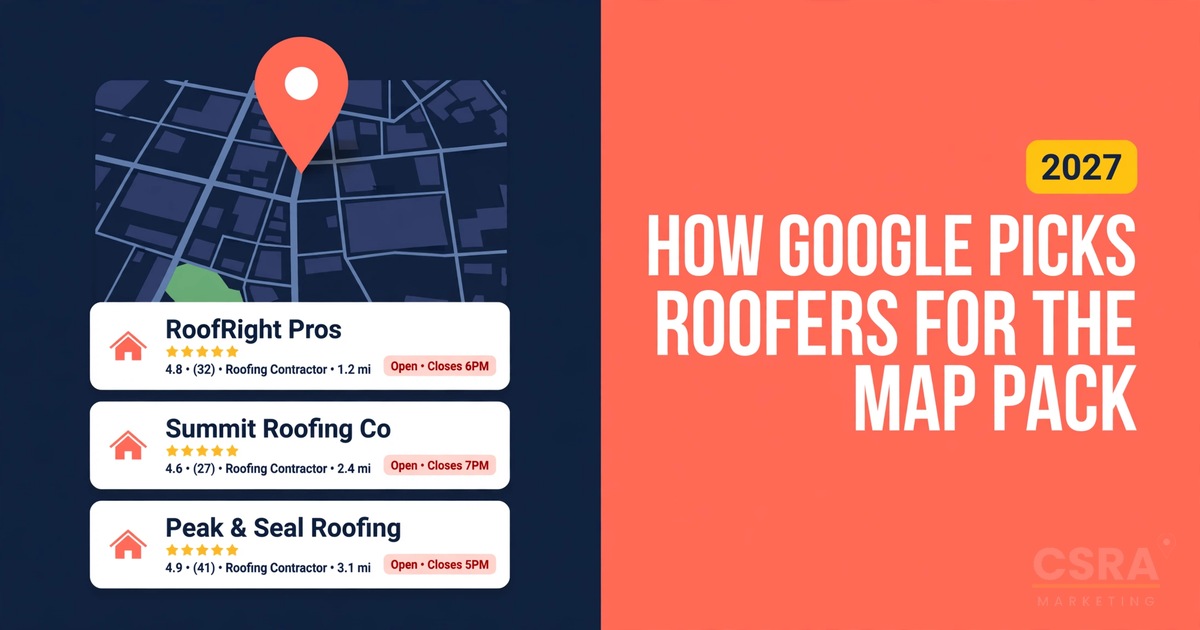
How Google Ranks Roofers in the Map Pack
How Google picks the three roofers in the map pack, and how the ranking works.

Kemar Lawrence is the co-founder of CSRA Marketing, where he leads growth strategy for roofing companies. He looks at marketing the way an owner looks at a P&L: what you invest, what it brings in and how fast it pays back. Websites, local SEO and Google Business Profile are just the tools. The goal is more booked jobs at a lower cost per lead.