
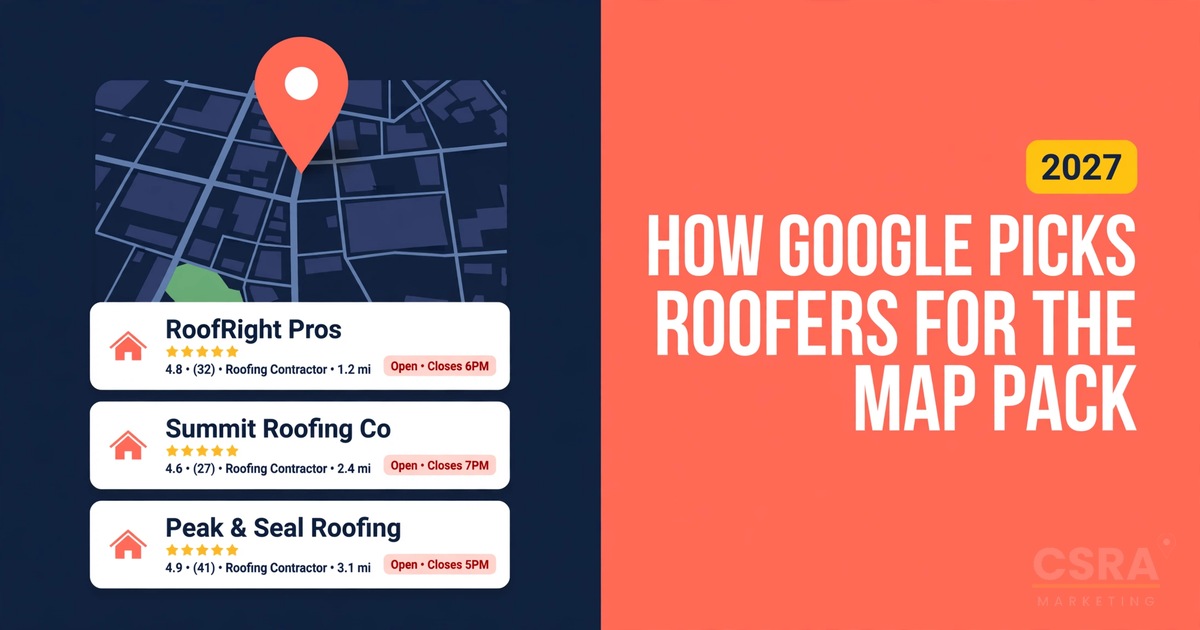
Google shows 3 roofers at the top of almost every "roofer near me" search. Those 3 spots get the calls.
I will show you the 3 factors Google uses to pick them, what you can control, and the myths that cost roofers real money.
Run your numbers through my lead cost comparison tool to see what a top-3 spot is worth to you.
Chapter 01
Those 3 Map Spots Get the Calls. Everyone Else Fights for Scraps.
Search "roofer near me" on your phone right now. Before you see a single website, you see a map with 3 business listings under it. That is the Map Pack.
Those 3 listings sit above every organic result on mobile. The roofer in position 4 might as well be invisible. In most markets, a roofer outside the top 3 waits for scraps. The map answers the homeowner's question before they ever scroll.
Why?
Because the Map Pack answers the only 3 questions a homeowner has: who is nearby, are they legit, and how do I call them. Phone number, reviews, directions. All in one tap.
Here is the part most roofers miss. Google tells you exactly how it picks those 3 businesses. It publishes the ranking factors in its own business help documentation. Three factors: relevance, distance, and prominence.
No guessing required. The rest of this post breaks down what each factor actually means for a roofing company, with examples you can act on this week.
Illustrative example: if a top-3 spot delivers 10 inbound calls a month in a mid-size metro, and you close 3 of those, and the average roof runs $12,000 at 40% gross margin, that is $14,400 in gross profit per month from one channel. What you pay to rank determines your cost per lead.
My local SEO service page covers how I plan all three factors into one campaign. And if you are new to the concept entirely, start with what local SEO actually is for roofers first.
Chapter 02
Proximity: You Cannot Move Your Shop, But You Are Not Helpless
Proximity means distance. Google measures how far your business location is from the person searching.
A homeowner in Evans searches "roof repair." Google favors roofers with a verified address near Evans. A roofer 40 minutes away starts at a disadvantage no matter how good their website is.
This is the one factor you cannot fully control. You cannot pick up your office and move it next to every customer. Your address is your address.
But here is what most roofers get wrong about proximity. They assume it only means their office address. It is wider than that.
Google also looks at your service area settings. If you serve 12 towns, say so in your business profile. A roofer in Martinez who lists Evans, Grovetown, and Augusta as service areas has a better shot in those towns than one who left the field blank.
Second, proximity is measured per search, not once. Every homeowner searches from a different spot. You do not need to win the whole metro. You need to win the searches happening near you, repeatedly.
Bottom line? Proximity is your starting position, not your destiny. The other two factors are where you make up ground.
Chapter 03
Relevance: Tell Google Exactly What You Do, In Google's Own Language
Relevance answers one question: does this business match what the searcher typed?
A homeowner searches "metal roof installation." Google scans business profiles for the closest match. A roofer whose profile lists "metal roofing" as a service beats a roofer whose profile just says "roofing contractor," even if both do metal roofs.
Most roofing profiles I review are half empty. They picked one category three years ago and never touched the services list. That is relevance left on the table.
Here is the deal: Google gives you the fields. Use all of them.
Your primary category should be "Roofing contractor." Then add every service you actually perform: roof replacement, roof repair, metal roofing, gutter installation, storm damage inspection, emergency roof repair. Each one is a keyword Google can match you to.
Your business description matters too. Write it in plain language a homeowner would use, not industry jargon. "We replace and repair residential roofs" beats "full-service exterior envelope solutions" every time.
Why?
Because Google matches words. When a homeowner types "emergency roof repair" at 11 PM during a storm, the roofer whose profile literally says "emergency roof repair" wins the relevance round.
One warning. Do not stuff keywords where they do not belong. Adding "BEST ROOFER CHEAP ROOFS ATLANTA" to your business name will get you penalized, not ranked. Google's guidelines are explicit about this, and competitors report violations.
Chapter 04
Prominence: This Is the Factor You Can Win Outright
Prominence is Google's measure of how well known and trusted your business is. It is the only factor where a small roofer can beat a big one through effort alone.
Google builds prominence from three main signals.
First, reviews. Quantity, rating, and recency. A roofer with 120 recent reviews at 4.8 stars looks more prominent than one with 14 reviews from 2021. Google lists reviews as a prominence signal in its ranking documentation. Quantity and positive ratings get called out directly.
The review game has one rule that matters more than the rest: in my experience, recency is the highest-leverage review signal. Ten reviews from this month outweigh fifty from two years ago. A steady stream of new reviews tells Google you are active and trusted right now.
Second, links and mentions from other websites. When local news sites, supplier pages, and community organizations link to your site, Google reads that as prominence. This is the hardest signal to build and the one most roofers ignore completely.
Third, complete and consistent business information across the web. Your name, address, and phone number should match everywhere they appear: your website, your Google profile, directories, social pages. Inconsistencies confuse Google and cost you prominence.
Prominence is the long game, and it is where rankings are actually won. The roofer who collects reviews every week and builds local mentions for a year does not just rank. They become hard to dislodge.
See how long that prominence building typically takes before the phone starts ringing.
Want to know what a top-3 Map Pack spot is worth in dollars?
Most roofers are surprised when they see the real number.
Compare Your Lead CostsChapter 05
Stop Stressing About the Parts You Cannot Change
Let me put the three factors on a spectrum so you know where your effort goes.
Mostly out of your hands: your physical location relative to each searcher. You serve the area you serve.
Fully in your hands, fixable this week: relevance. Complete your categories, list every service, write a plain-language description. This is a few hours of work with an outsized payoff.
Fully in your hands, compounds over months: prominence. Review generation every week. Accurate listings everywhere. Local links and mentions built steadily.
The mistake I see constantly: roofers obsess over proximity ("my competitor is closer to downtown!") while their own profile is half empty and their last review is from 14 months ago. They are losing on the two factors they could win.
Control what you can control. The roofer who maxes out relevance and grinds on prominence removes Google's reason to prefer the closer competitor. The two factors you can control outweigh the one you cannot.
And if you are weighing whether SEO is worth the monthly investment at all, here is what roofing SEO actually costs and what it buys you.
Chapter 06
3 Map Pack Myths I Hear Every Month
Myth 1: "Google Ads will boost my Map Pack ranking."
They will not. Ads and the Map Pack are separate systems. Buying ads does not move your organic map position one inch. Google's documentation is clear that ad spend is not a ranking factor. Ads buy you the top of the page while you pay. The Map Pack has to be earned.
Myth 2: "More reviews automatically means a higher rank."
Reviews are one signal inside prominence, not the whole factor. A roofer with 300 reviews and an incomplete profile, wrong categories, and inconsistent listings can lose to a roofer with 80 reviews who nailed everything else. Reviews matter enormously. They are not the entire game.
Myth 3: "I need a physical office in every city I want to rank in."
You need one real, verified location. From there, service areas plus relevance plus prominence determine how far your ranking radius extends. Plenty of roofers rank across a 30-mile service area from a single office. What you cannot do is fake additional locations with PO boxes or virtual offices. Google suspends profiles for that. Reinstatement requires a formal appeal and can take weeks, sometimes longer.
Chapter 07
5 Things to Fix Before Next Monday
If you do nothing else after reading this, do these five things. They are free and they take one afternoon.
- Claim and verify your Google Business Profile. If you have not claimed it, someone else's outdated information might be ranking instead of yours.
- Set your primary category to "Roofing contractor." Not "General contractor." Not "Construction company." The exact category matters for relevance.
- List every service you perform. Roof replacement, roof repair, metal roofing, gutters, storm damage, emergency repair. Each one is a search term you can now match.
- Define your service areas. List every town you actually serve. This is how you stretch your proximity beyond your office address.
- Ask your last 5 happy customers for reviews. Text them a direct link today. Recency is the highest-leverage review signal and most roofers have nothing from the last 90 days.
Do those five and you have already passed half the roofers in your market on relevance alone. Prominence is the longer grind, but it starts with review number one.
Frequently asked questions
What is the Google Map Pack?
The Map Pack is the block of 3 local business listings Google shows with a map at the top of local searches like "roofer near me." It appears above organic website results on mobile and captures the majority of clicks and calls for local service searches.
How long does it take to rank in the Map Pack?
Plan on 4 to 6 months of consistent work (a typical timeline, not a guarantee). Relevance fixes can move the needle in weeks. Prominence, which carries the most weight over time, builds over months as reviews accumulate and your business information spreads across the web. Here is a month-by-month breakdown of what to expect.
Does having the most reviews guarantee the number one spot?
No. Reviews are one signal inside the prominence factor. A roofer with fewer reviews but a complete profile, correct categories, and consistent listings can outrank a competitor with more reviews. That said, review quantity, rating, and especially recency are among the highest-leverage signals you control.
Can I rank in the Map Pack in cities where I do not have an office?
You can rank across your service area from a single verified location. Set your service areas in your business profile, build relevance for those towns, and grow prominence. What you cannot do is create fake additional locations. Google suspends profiles that use PO boxes or virtual offices as their address.
Do Google Ads help my Map Pack ranking?
No. Google Ads and Map Pack rankings run on completely separate systems, and ad spend is not a ranking factor. Ads put you at the top of the page while you are paying. Map Pack placement has to be earned through relevance, proximity, and prominence.
What hurts Map Pack rankings the most?
The fastest ways to damage your ranking are an unclaimed or unverified profile, a suspended profile (usually from address violations), wildly inconsistent business information across the web, and a long stretch with zero new reviews. Any one of these can drop you out of the top 3 even if everything else is solid.
Should I hire someone to handle this or do it myself?
The one-afternoon fixes in Chapter 07 you can do yourself today. The ongoing work, weekly review generation, listing cleanup across dozens of directories, and building local prominence, is where most owners run out of hours. That is exactly what a local SEO campaign covers. Either way, start with the free fixes now.

Kemar Lawrence is the co-founder of CSRA Marketing, where he leads growth strategy for roofing companies. He looks at marketing the way an owner looks at a P&L: what you invest, what it brings in and how fast it pays back. Websites, local SEO and Google Business Profile are just the tools. The goal is more booked jobs at a lower cost per lead.