
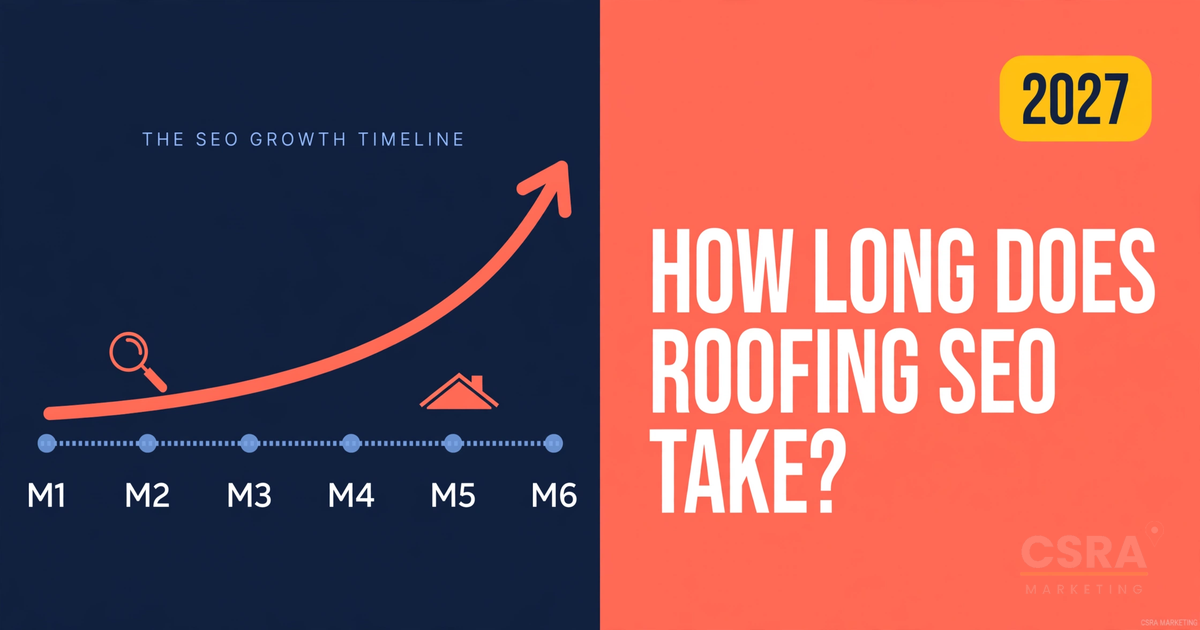
Six months. That is the honest answer to how long roofing SEO takes to generate real leads.
In this guide I walk you through exactly what happens in each phase, why Google needs that much time, and the early signals that tell you the campaign is working long before the phone rings.
Run your numbers through our lead cost comparison tool first. It will show you what those six months of waiting are actually buying you.
Chapter 01
The short answer: plan on six months
If you hire someone for roofing SEO today, expect meaningful lead volume around month six. Not month one. Not month three. Month six, give or take.
That is not a guess. Six months is the planning timeline the local SEO industry works from, and it is the number I plan every campaign around. Some markets move faster. Some slower. But six months is the honest planning number.
Here's the deal: anyone who tells you 30 days is either confused or lying. Google does not hand out trust on a schedule you get to choose. Our local SEO service is built around this exact timeline, because pretending it is faster helps no one.
Chapter 02
Months 1 to 2: foundation (you will see almost nothing)
The first two months are the least exciting and the most important.
This is when the real work gets set up: your site gets fixed where it is broken, your Google Business Profile gets rebuilt properly, your review system starts running, and your service pages get built out for each city you serve. If the site itself is the bottleneck, these are the seven things every roofing website needs to turn visitors into calls. None of this is visible to you as a roofer. It all happens under the hood.
Why does this take two months? Because doing it right means touching dozens of things, and each one needs to be checked. A rushed foundation is the number one reason campaigns stall at month five.
You will see almost no change in calls during this phase. That is normal. That is expected. If your provider is honest, they told you this on day one. If they promised movement in week three, that is a problem.
Chapter 03
Months 3 to 4: first signals (not leads yet, but proof)
Around month three, things start twitching. Not ringing. Twitching.
Your Google Business Profile starts appearing for searches it missed before. A few keywords climb from page three to page two. You might get one or two calls from organic search in a good month. These are signals, not results. Treat them that way.
Why?
Because Google is testing you. When new pages go live and a profile gets active, Google watches how searchers respond before it commits to ranking you higher. This testing period is built into how search works. Google's own documentation on how search works confirms that discovering, indexing, and evaluating new content is a process, not an event.
Most roofers get impatient right here. Month four feels like a lot of money for a handful of calls. I get it. But quitting at month four is like pulling a cake out at minute twelve. The ingredients were right. The timer was not done.
Chapter 04
Months 5 to 6: the curve bends (leads start arriving)
This is when it gets real.
Between months five and six, the signals from the last phase start converting into actual calls. Your map pack presence stabilizes for your main searches. Organic calls go from "one or two" to a steady weekly trickle. For a typical single-market roofer, this is when SEO becomes a line item worth tracking (illustrative timeline based on typical campaign patterns).
The month-six breakeven walkthrough
($1,500/mo)
(illustrative)
$4,800 gross profit
At $4,800 gross profit per roof ($12,000 job at 40% margin), the campaign approaches monthly breakeven at month six. And it is still climbing.
Month six is not the finish line. It is the starting line. Everything before it was building the engine. From here, the engine runs.
Chapter 05
Why Google needs this much time (the real reasons)
Roofers always ask me why it cannot be faster. Fair question. Three reasons, none of which anyone can shortcut.
First: trust is earned on Google's clock, not yours. Google ranks businesses it trusts to satisfy searchers. Trust comes from consistency over time: steady reviews, an active profile, real engagement. You cannot backdate trust. A profile with six months of steady activity outranks a profile with six days of frantic activity every time.
Second: your competitors did not pause while you started. The roofers ranking now have a head start measured in months or years. You are not climbing an empty hill. You are passing companies that are still climbing too. Catching up takes the time it takes.
Third: Google tests before it commits. New and improved pages go through an evaluation period where Google measures how searchers interact with them. This is not a penalty. It is quality control. Rushing it is not possible, and trying to game it is how sites get filtered out entirely.
Anyone selling you a shortcut around these three things is selling you risk, not speed. I wrote about what happens when agencies cut corners in my guide on whether roofing SEO actually works.
See what six months of waiting is actually buying you
Plug your current lead spend into the Lead Cost Comparison tool and see your 12 and 24-month picture next to an SEO investment. Two minutes, no email required.
Compare Your Lead CostsChapter 06
Can you speed it up? (honest answer: a little)
You cannot cut the timeline in half. But you can shave time off it.
What actually helps: having 50+ real reviews on day one instead of starting from zero. A website that is already fast and mobile-friendly instead of needing a rebuild. Operating in a smaller market with fewer competitors. Publishing in a city where you already have brand recognition. Each of these can pull the timeline toward four months instead of six.
What does not help: paying more per month. Doubling the budget does not double Google's trust speed. It just means you spend more while you wait. Above a certain point, extra spend buys breadth (more cities, more services), not speed.
What actively hurts: switching providers at month three because you are impatient. Every restart resets the clock. I have watched roofers burn eighteen months and three providers, when one provider for twelve months would have had them ranking. Impatience is the most expensive SEO mistake.
For what a campaign should actually cost at each level, see my roofing SEO cost guide.
Chapter 07
How to know it is working before the phone rings
This is the chapter most roofers need but never get. You do not have to wait six months blind. There are leading indicators that prove the campaign is on track.
- Indicator one: your profile views climb. Google Business Profile shows you how many people saw your listing. If that number rises month over month, visibility is growing. Visibility comes before calls. Always.
- Indicator two: keyword movement. Your provider should show you a simple list: these searches, this position last month, this position now. You want to see steady upward movement, even if it is from position 28 to position 14. Direction matters more than destination in months three and four.
- Indicator three: review velocity. If you started at 12 reviews and you are at 45 by month four, the engine is running. Reviews are both a ranking factor and a conversion factor. They compound.
- Indicator four: the phone starts with the easy wins. The first organic calls usually come from less competitive searches: your brand name, a small nearby town, a specific service. That is Google testing you on the easy queries before trusting you with "roofer near me." It is a good sign, not a small one.
Ask your provider for these four numbers every month. If all four are flat at month four, the campaign has a problem. If three of four are climbing, stay the course.
Chapter 08
The real cost of waiting (and the cost of not starting)
Here is the math nobody shows you.
Every month you wait to start SEO is a month you will wait later. If you start today, month six is April. If you start in April, month six is October. The timeline does not compress because you delayed. Delay just moves the payoff further out.
Meanwhile, the roofers ranking in your market right now started months ago. Every month they compound, the gap widens. In my experience, the difference between starting now and starting in six months is not six months of results. It is closer to nine or twelve, because you also have to close a bigger gap.
The waiting period feels expensive. $1,500 a month with no calls hurts. But compare it to the alternative most roofers choose: buying shared leads at $50 to $120 each (typical market range) indefinitely, with costs that never drop and close rates far below what exclusive inbound calls produce, because three other roofers got the same lead.
Run both during the ramp if you need to. Keep the trucks moving with bought leads. But start the SEO clock now. The most expensive SEO campaign is the one you start a year late.
Frequently asked questions
How long does roofing SEO take to generate leads?
Plan on six months as a working guideline before a campaign generates meaningful lead volume. You may see early signals at months 3 to 4, like profile view growth and keyword movement. Steady organic calls typically start between months 5 and 6. Competitive markets can push this to 8 months.
Why does SEO take so long for roofers?
Three reasons: Google builds trust on its own timeline and you cannot shortcut it, your competitors have a head start you need to close, and Google tests new or improved pages before committing to higher rankings. Each of these is structural. No provider can bypass them without risking the campaign.
Can you speed up roofing SEO results?
A little. Starting with 50+ real reviews, an already-fast website, or a smaller market can pull the timeline toward four months. But paying more per month does not make Google trust you faster. The biggest timeline killer is switching providers mid-campaign, which resets the clock.
How do I know my SEO is working before I get leads?
Watch four leading indicators: Google Business Profile views climbing month over month, steady upward keyword movement (even from position 28 to 14), review count growing, and early calls from less competitive searches like your brand name or nearby towns. If three of four are climbing by month four, the campaign is on track.
Should I buy leads while waiting for SEO to work?
Yes, if you need jobs now. Most roofers run both during the ramp: bought leads keep the trucks moving, SEO builds the asset that eventually replaces that spend. Shared leads run $50 to $120 each (typical market range) and close at a fraction of the rate of exclusive inbound calls. Treat the SEO spend as the investment and the lead buying as the bridge.
What happens if I quit SEO at month 4?
You lose most of what you paid for. The foundation work from months 1 to 2 only pays off if months 3 through 6 are allowed to compound on top of it. Quitting at month four is the most common and most expensive SEO mistake roofers make. If the leading indicators are flat at month four, fix the campaign. Do not abandon the channel.
Is 6 months guaranteed?
No, and anyone who guarantees a timeline is selling you something. Six months is a planning guideline based on typical campaign patterns in competitive local markets. Smaller markets can move faster. Brutal metros can take longer. What matters is the direction of your leading indicators, not a date on a calendar.

Kemar Lawrence is the co-founder of CSRA Marketing, where he leads growth strategy for roofing companies. He looks at marketing the way an owner looks at a P&L: what you invest, what it brings in and how fast it pays back. Websites, local SEO and Google Business Profile are just the tools. The goal is more booked jobs at a lower cost per lead.