
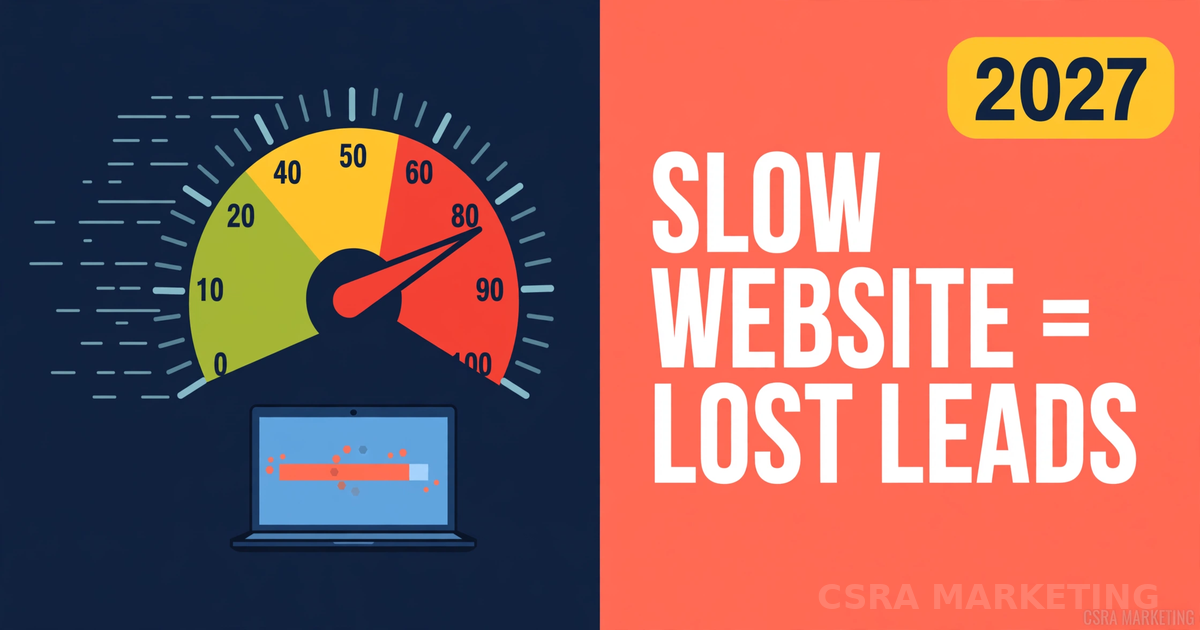
Your roofing website speed is costing you leads every single day.
In this post, I'll show you how much revenue a slow site leaks in lost jobs, the three things that make roofing sites slow, and what "fast enough" actually looks like.
After reading, run your site through Google's free speed testing tool. You'll know exactly where you stand in two minutes.
Chapter 01
A Slow Page Does Not Just Annoy People. It Sends Them to Your Competitor.
Here's the deal: a homeowner with a leaking roof is not a patient person.
They tap your link, stare at a blank screen for four seconds, and hit the back button. Your competitor's site loads in two seconds, so they call your competitor instead.
Google's own analysis of Chrome user experience data found that sites meeting its speed thresholds see 24% lower page abandonment than sites that do not. (Google News Initiative, "Keep visitors engaged with Core Web Vitals")
That is not a rounding error. That is nearly one in four visitors who would have stayed, gone.
And roofing traffic is expensive to earn. Every visitor who bounces before the page loads is a click you paid for or a ranking you fought for, wasted.
If your site feels slow to you, it feels slow to them. Trust that instinct. It is usually right. This is one of the first things I check on any roofing web design project, because roofing website speed is a lead problem before it is a tech problem.
Chapter 02
What "Fast Enough" Actually Looks Like (in Plain English)
Google grades every page on three speed measurements, and you do not need to memorize their names.
All that matters is this: your main content should be visible in under 2.5 seconds on a phone. That is the line Google draws between "good" and "needs work."
Why?
Because the 2025 Web Almanac found that only 48% of mobile websites pass all of Google's speed thresholds. More than half the web is slow, which means being fast is still a genuine competitive edge.
Here is the part that should get your attention: Google uses these speed scores as a ranking tiebreaker. When two roofing sites are equally relevant, the faster one wins the higher spot.
So speed is not just about keeping visitors. It is about getting them in the first place.
A site that loads in under 2.5 seconds keeps more visitors AND ranks better. A slow site loses on both ends. That double penalty is what makes speed one of the highest-leverage fixes on your entire website.
Chapter 03
The 3 Things That Make Roofing Sites Slow
Almost every slow roofing site I have ever looked at suffers from the same three problems.
First: oversized images. A roofer uploads a 4MB photo straight from their phone, and the site tries to load the full file on every visit. In my experience, one unoptimized hero image can add two full seconds to your load time.
Second: plugin pileup. Most add-ons bolted onto the site load their own code, and they do not coordinate with each other. In my experience reviewing roofing sites, a typical install runs 15 to 25 active plugins, and each one takes its cut.
Third: bloated themes. Most roofing sites are built on heavy pre-made themes packed with features nobody uses. You are loading code for twelve layouts when your site only shows one.
Bottom line? Your site is not slow because of one big thing. It is slow because of twenty small things stacked on top of each other.
The good news: that also means small fixes add up fast. Trim the images, cut the dead weight, and most sites drop seconds, not milliseconds.
Chapter 04
How to Check Your Own Speed in 2 Minutes
Google offers a free speed testing tool. Type in your URL and it scores your page on mobile and desktop.
Here is what most roofers get wrong about the score: the lab score is not the real score. Google judges what your actual visitors experience, at the 75th percentile, not your best test run on fast wifi.
So test like your customer browses. Check the mobile score, not just desktop. More than half of your traffic is on a phone, standing in a driveway, on a mediocre connection.
What you want to see: the main content visible in under 2.5 seconds, and no layout jumping while the page loads. (Layout jumping is when the text shifts as images pop in. Visitors hate it, and Google penalizes it.)
If your mobile score is poor, do not panic. Most roofing sites score poorly. That is exactly why fixing it puts you ahead.
If your test comes back ugly, the platform question matters: here is how WordPress and custom sites compare on speed.
Lost Revenue Calculator
Drag the sliders to your own numbers and see what missed searches cost in jobs you never hear about.
Chapter 05
The Revenue Math: What 3 Extra Seconds Cost You Per Year
This is the chapter that matters. Let me walk you through an illustrative worked example so you can see the leak in dollars.
Say your site gets 500 visitors a month and loads in about 6 seconds. A typical bounce rate at that speed is around 60%. That means 300 visitors leave before they ever see your content. Only 200 stick around.
Now imagine the same site loading in under 3 seconds, with a typical bounce rate around 40%. Now 300 visitors stay instead of 200. That is 100 extra real humans looking at your business every month.
Say 5% of the visitors who stay end up calling (a typical range for a decent roofing site). That is 10 calls on the slow site versus 15 on the fast one.
At a 30% close rate (my professional read from industry patterns, not a published benchmark), that is 3 jobs versus 4.5 jobs per month.
At $4,800 gross profit per roof (a $12,000 job at 40% margin), the slow site books $14,400 a month. The fast site books $21,600.
The difference: roughly $7,200 a month, or about $86,000 a year, lost to three extra seconds of loading.
Three seconds. Eighty-six thousand dollars a year. That is not a tech problem. That is a P&L problem.
Slow site vs. fast site, same 500 visitors a month
Illustrative worked example: $4,800 gross profit per roof.
What is slow speed costing YOUR business?
That $86,000 figure is based on example traffic. Run your actual numbers through the lost revenue calculator and see what slow pages are costing your business specifically.
Calculate My Lost RevenueChapter 06
The 4 Fixes That Matter Most (Ignore Everything Else)
Speed advice on the internet is overwhelming, so let me simplify it. These four fixes cover the vast majority of the problem on roofing sites.
Fix one: shrink your images. Your photos do not need to be print quality. Properly sized images are the single biggest win on most roofing sites.
Fix two: cut what you do not use. Every plugin, pop-up, and tracking script loads code. If it does not book jobs, it does not belong on the page.
Fix three: stop the layout jumping. Reserve space for images and banners so the page does not shift while loading. Visitors trust a stable page more, and Google scores it higher.
Fix four: cache aggressively. A cached page loads dramatically faster for repeat visitors. Your developer should have this handled, but ask. Many do not.
Notice what is NOT on this list: buying a faster server, rebuilding the whole site, or any exotic trick. For most roofing sites, the basics fix 80% of the problem.
And if you are wondering what a proper speed-optimized build runs, here is what roofing websites actually cost. Speed is also one of the seven things every roofing site needs: see the full checklist here.
Chapter 07
Roofing Website Speed Is Quietly an SEO Problem Too
Most roofers think of speed as a user experience thing. It is also a rankings thing, and the two feed each other.
Remember the tiebreaker: when two sites are equally relevant, Google ranks the faster one higher. In a competitive market where three roofers are fighting for the same map pack and organic spots, that tiebreaker decides who gets the click.
And there is a second-order effect nobody talks about. When visitors land and leave immediately, Chrome's user experience data captures it. Google uses real-world engagement patterns, not just your analytics, to judge whether a page satisfied the searcher.
So a slow site gets fewer visitors from Google AND converts fewer of the ones it gets. The leak compounds.
Google's own Core Web Vitals guidance confirms that page experience signals feed into how Google evaluates and ranks pages. Speed is not the whole SEO game, but it is a multiplier on everything else you do.
Fix the speed and your SEO gets easier.
If you want to know exactly where your site stands, run my Roofing Website Score. I'll check your speed, your rankings, and your lead flow, and show you what is costing you jobs. Or book a 30-minute call and I'll walk through it with you personally.
Frequently asked questions
How fast should my roofing website load?
Your main content should be visible in under 2.5 seconds on a phone. That is Google's "good" threshold, and it is the line that separates sites that keep visitors from sites that bleed them.
Does website speed really affect my Google rankings?
Yes, as a tiebreaker. When two sites are equally relevant, Google ranks the faster one higher. It is not the biggest ranking factor, but in competitive markets it decides who gets the click.
What is the biggest reason roofing websites load slowly?
Oversized images, in my experience. Roofers upload full-resolution phone photos, and a single 4MB hero image can add two seconds to load time. Shrinking your images is almost always the biggest single win.
Will a faster website actually get me more leads?
The data says yes. Google's own research found 24% lower abandonment on sites that meet its speed thresholds, and the 2025 Web Almanac found that only 48% of mobile websites pass those thresholds. Faster pages keep more visitors, and more visitors means more calls.
Is checking my site on my own phone a reliable speed test?
Not really. Your phone has the site cached and you are probably on good wifi. Use Google's free speed testing tool and look at the mobile field data, which reflects what real visitors experience on real connections.
How often should I check my website speed?
Quarterly at minimum. Every plugin update, image upload, or theme change can quietly add weight. I recommend checking after any site change and doing a full review every three months.
Do I need a whole new website to get a fast one?
Usually not. Most roofing sites can drop seconds by shrinking images, cleaning up plugins, and caching. A rebuild only makes sense if the underlying platform is fundamentally bloated. If you are on the fence, this WordPress versus custom breakdown will help you decide.

What Should a Roofing Website Include to Turn Visitors Into Leads?
The seven things a roofing website needs, and how each one turns a visitor into a call.
WordPress vs Custom: What's the Best Website Platform for Roofers in 2027?
WordPress versus custom sites for roofers, and which platform fits which company.
How much does a roofing website cost?
Real prices for a roofing website, what you get at each price, and the math behind the cost.

Kemar Lawrence is the co-founder of CSRA Marketing, where he leads growth strategy for roofing companies. He looks at marketing the way an owner looks at a P&L: what you invest, what it brings in and how fast it pays back. Websites, local SEO and Google Business Profile are just the tools. The goal is more booked jobs at a lower cost per lead.