
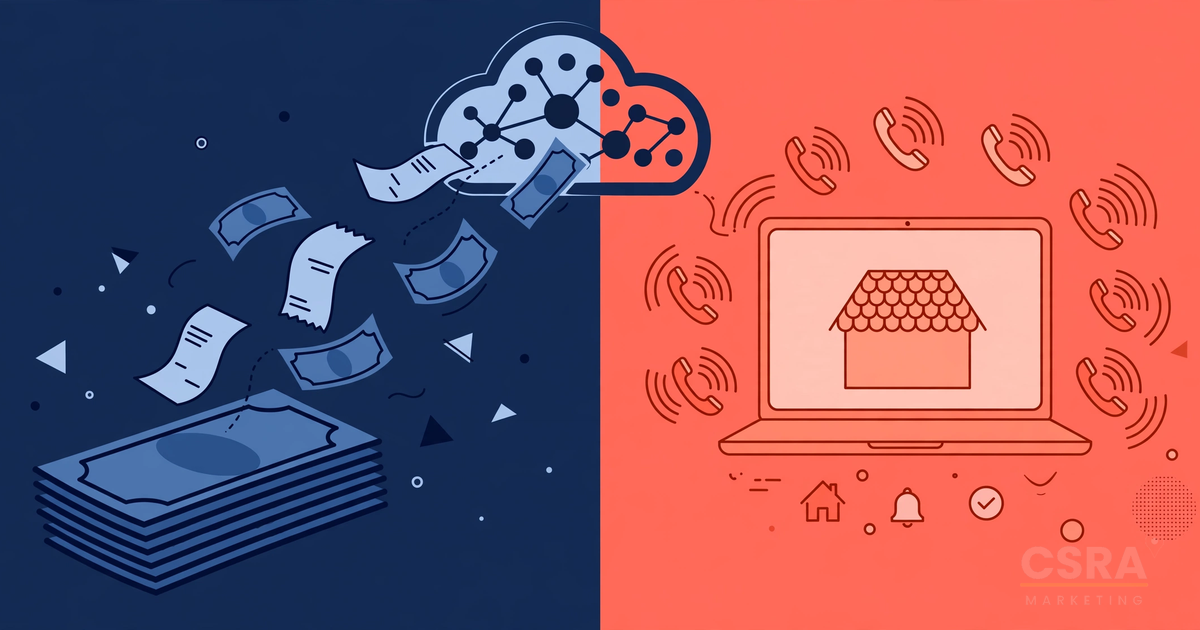
I ran the 24-month math both ways. The answer surprised even me.
This post breaks down what shared leads actually cost per booked job, what the same budget buys when you invest it in your own site and SEO, and the exact point where owning beats renting.
Let's get into it.
Chapter 01
The short answer: stop renting your leads
If you're spending more than $1,000 a month on shared leads and plan to be in business two years from now, you're almost certainly better off investing that budget in your own website and SEO.
Here's why in one sentence: every dollar you spend on Angi buys you a lead once, but every dollar you spend on your own site keeps working after you stop paying.
The rest of this post shows you the math so you can check it yourself.
Chapter 02
Why your $75 lead actually costs $750 per booked job
Let's start with what the invoice says versus what it really costs.
Roofing leads from shared marketplaces typically run $50 to $120 per lead (typical market range; varies by platform and market). Say you're paying $75 a lead and buying 20 a month. That's $1,500 a month, $18,000 a year, $36,000 over two years.
But here's the deal: that $75 lead typically goes to 3 to 5 other roofers at the same time (typical market range). You're not buying a lead. You're buying a lottery ticket.
Shared leads close at roughly 5 to 15% for most roofers (typical market range). At 10%, your 20 leads a month turn into 2 booked jobs. Your $1,500 bought 2 jobs. That's $750 per booked job.
And the day you stop paying? The leads stop the same day. You own nothing.
Chapter 03
The 24-month math, side by side
| Angi (24 months) | Own website + SEO (24 months) | |
|---|---|---|
| Total spend | $36,000 | $36,000 |
| Leads per month (avg) | 20 shared | 0 → 15+ organic, illustrative (grows) |
| Close rate | ~10% (shared) | ~30% (exclusive, illustrative) |
| Booked jobs/month | ~2 | 0 → 4+ (grows) |
| What you own at month 24 | Nothing | A ranking website |
The catch? Months 1 through 6 favor Angi. Your site is new, SEO takes time, and the leads aren't flowing yet. You're spending money and waiting.
But here's what the table doesn't show: the curve. Angi's line is flat: $1,500 in, 2 jobs out, every month, forever. Your website's line curves up. Month 12 beats month 6. Month 24 beats month 12. And at month 25, when the Angi buyer is still paying $1,500, your site is still generating leads from money you already spent.
Let me put profit on it. A $12,000 roof at 40% gross margin is $4,800 in profit per job. Two jobs a month from Angi is $9,600 in gross profit against $1,500 in lead spend. That looks fine on paper.
But here's what the table doesn't show yet: at month 18 on your own site, those 4+ jobs a month are $19,200 in gross profit against roughly the same monthly spend. And the spend stops compounding against you the day you own the asset. (Illustrative math: plug in your own ticket size and margin.)
These are illustrative numbers. Swap in your own lead costs and close rates. But the shape of the curve is the point, not the exact figures.
Run your own numbers before you decide
Plug what you're actually paying per lead into the Lead Cost Comparison tool and see your 24-month picture.
Compare Your Lead CostsChapter 04
Why every dollar you spend on SEO is still working at month 25
Think about it this way: Angi is rent. Your website is a mortgage.
Every month you pay rent, you get a place to sleep that month. Every month you pay a mortgage, you get a place to sleep AND you own a little more of the building.
SEO works the same way. Every article you publish, every review you earn, every local citation you build, it stacks. Month 18's rankings are built on month 6's work. Nobody can take that away from you unless you let the site rot.
Yes, a website needs ongoing SEO the way a house needs maintenance. But at month 24, you still own the asset.
With Angi, month 18 looks exactly like month 1. Same $75 leads. Same 4 competitors calling the homeowner before you. Same $750 per booked job.
The question isn't whether SEO is slower at first. It is. The question is whether you want to be having this same conversation and writing this same check , in 2029.
Chapter 05
What $36,000 buys you: two paths, one decision
So what does "invest in your own website" mean in practice? Two parts.
Part one: the website. A professional roofing site: custom design, real copywriting, fast on phones, built to convert visitors into calls, runs $2,000 to $5,000 as a one-time cost (typical market range). This is the foundation. Without it, SEO has nowhere to send traffic.
Part two: monthly SEO. A real local SEO campaign for a roofing company covers Google Business Profile management, review strategy, local content, authority links, technical maintenance, runs $1,500 to $5,000 a month (typical market range). The range depends on your market's competitiveness.
Add them up over 24 months and you're in the same neighborhood as the Angi spend. The difference is what you have at the end.
One thing I want to be straight about: this only works if the SEO is real. A low-cost "SEO package" that sends you a PDF report every month is not this. That's just a cheaper way to waste money.
Chapter 06
When buying leads still makes sense
I'll be honest: there are times when Angi is the right call.
If you just started your company and need jobs this month, SEO will not save you. It takes 4 to 8 months as a working guideline before a campaign hits its stride. You can't eat rankings.
If you're in a slow season and need to fill the schedule fast, a short burst of paid leads can bridge the gap while your organic presence builds.
And if you've tried SEO before with a bad provider and got burned, I get the skepticism. Not every campaign works. The provider matters more than the channel.
But "buy leads forever" is not a strategy. It is a subscription to someone else's business model. Use paid leads as a bridge, not a destination.
Chapter 07
How to make the switch
If the math makes sense, here's how I'd do it.
Step #1: Don't cancel Angi tomorrow. Keep the leads flowing while you build. The worst move is cutting revenue before the replacement is ready.
Step #2: Get the website built first. This takes 2 to 4 weeks with a good partner. It's the asset everything else points to.
Step #3: Start SEO while the site is being built. Good providers can start technical work, keyword research, and content planning before launch. You want momentum on day one, not day thirty.
Step #4: Set a date to cut the cord. Pick a month, say month 9 or 12, where you will evaluate. If organic is covering the gap, reduce Angi spend. If it's not there yet, extend. But have the date. Open-ended subscriptions are how $36,000 disappears.
Step #5: Track cost per booked job, not cost per lead. This is the number that matters. If your blended cost per booked job from your own site drops below what Angi was charging you, the switch paid off. Most owners I talk to see this happen between months 9 and 14 (illustrative timeline).
Pro tip: run your own numbers through a lead cost comparison tool before you decide. Plug in what you're actually paying per lead, your actual close rate, and see what the 24-month picture looks like with your numbers instead of mine.
How much does Angi charge roofers per lead?
Roofing leads from shared marketplaces typically run $50 to $120 per lead (typical market range; varies by platform and market). The lead is shared with 3 to 5 other contractors, so your real cost per booked job is much higher than the per-lead price.
Is it better to buy roofing leads or invest in SEO?
Buying leads gives you jobs faster: this month, not next year. SEO gives you a lower cost per job over time and an asset you own. If you need work now, buy leads as a bridge. If you're planning 2+ years out, the math favors investing in your own website and SEO.
How long until SEO replaces my paid leads?
Plan on 4 to 8 months as a working guideline before a campaign hits its stride, and 9 to 14 months before organic fully replaces a paid lead budget (illustrative timeline). It varies by market competitiveness and how aggressive the campaign is.
What does a roofing SEO campaign cost per month?
A real local SEO campaign for a roofing company runs $1,500 to $5,000 a month (typical market range). Below that range you're usually getting automated reports, not actual work. The range depends on how competitive your market is.
Can I do SEO myself instead of hiring someone?
You can handle basics like asking for reviews and keeping your Google Business Profile updated. But technical SEO, content strategy, and authority building take real expertise and consistent hours every month. Most owners who try DIY stall out after 60 days because they're running a roofing company, not a marketing agency.
What happens if I stop paying for SEO?
Unlike Angi, where leads stop the day you cancel. A well-built site keeps ranking for months after you pause SEO. Rankings decay slowly without maintenance, they don't vanish overnight. That's the compounding effect: you keep most of what you built.
Should a new roofing company start with Angi or a website?
Both, in sequence. You need jobs now, so Angi or another lead source fills the gap. But start building the website immediately. Every month you delay is a month of compounding you are not getting. Set a date 9 to 12 months out to evaluate whether organic can take over.
How do I know if my SEO provider is actually doing work?
Ask for three things every month: what was published or built, what changed in rankings and traffic, and what is planned next. If you get a PDF full of charts but cannot point to a single new page, link, or ranking improvement, you are paying for reports, not SEO.

Kemar Lawrence is the co-founder of CSRA Marketing, where he leads growth strategy for roofing companies. He looks at marketing the way an owner looks at a P&L: what you invest, what it brings in and how fast it pays back. Websites, local SEO and Google Business Profile are just the tools. The goal is more booked jobs at a lower cost per lead.